

Pulsed Dye Laser V Beam II
Pulsed Dye Laser V Beam II
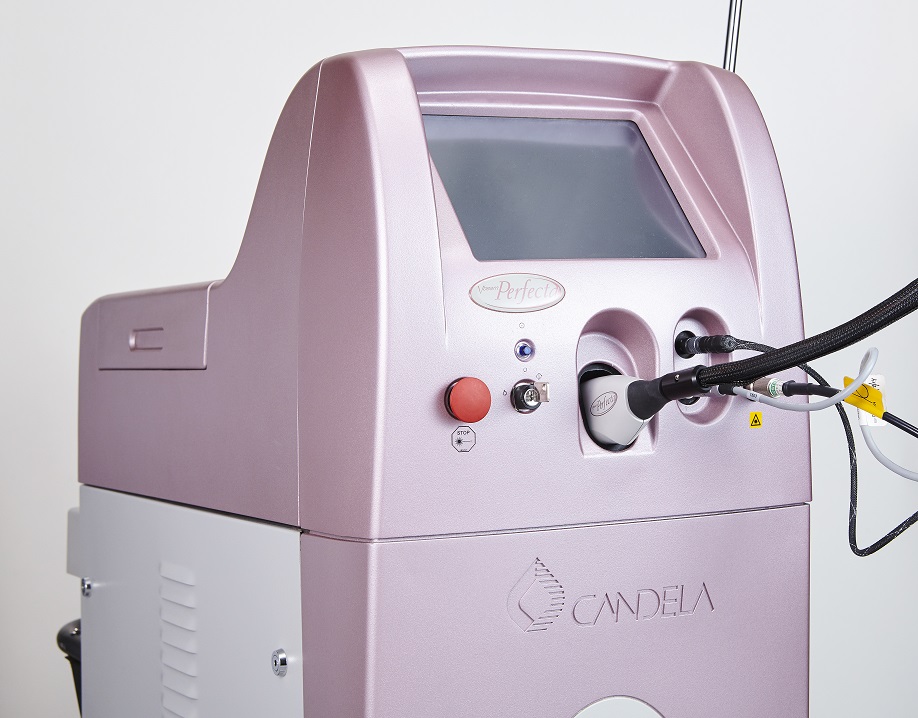
The pulsed dye laser is a dye laser with a wavelength of 595 nm. It is readily absorbed by the hemoglobin in the blood and is effective on lesions where blood vessels are dilated or proliferating.
At our clinic we use CANDELA’s V Beam II. Irradiation for red birthmarks such as capillary malformations and infantile hemangiomas is covered by insurance, and it is sometimes used to treat common warts (viral warts) and venous lakes. In aesthetic dermatology it is also used to improve facial redness and acne scars and for rejuvenation.
Features of the V Beam II
Selectively absorbed by hemoglobin
The laser light is selectively absorbed by the hemoglobin in the blood, and in a lesion where capillaries are clustered, the hemoglobin absorbs the laser’s light energy and converts it to heat, thermally destroying the inner walls of the vessels and occluding them.
Treatment with high irradiation energy is possible
The maximum irradiation output is higher than in conventional devices, enabling treatment with higher irradiation energy.
Little bruising
Because the pulse width is composed of eight micropulses (subpulses), safer treatment with reduced side effects such as purpura formation is possible.
Cooling reduces burns
The skin is protected by spraying a coolant just before the laser is applied.
Conditions for Which the Pulsed Dye Laser Is Indicated
- Capillary malformation (insurance covered)
- Infantile hemangioma (insurance covered)
- Telangiectasia
- Common warts
- Spider angioma
- Venous lake
- Acne scars
- Hypertrophic scars and keloids
- Rosacea
and others
The V Beam II in Aesthetic Dermatology
The pulsed dye laser V Beam II responds to red lesions. It is effective on fine blood vessels around the sides of the nose, the type of rosacea with clearly dilated vessels, red scars from acne, and red, raised hypertrophic scars and keloids.
Also, regardless of redness, applying it at low fluence (weaker power) has a rejuvenation effect, which we call V Beam Facial.
V Beam Facial
When the V Beam II is applied, it causes slight thermal damage within the dermis and activates fibroblasts, so elastin and collagen are rebuilt in the upper dermis, and a rejuvenation effect is said to be obtained. The effect differs with the location and depth of the wrinkles and the skin type. Also, because the 595 nm wavelength acts selectively on melanin pigment as well, an effect on shallow spots can also be expected. We recommend applying it to the whole face, but it can also be applied to specific areas.
The treatment is repeated four to six times at intervals of once every four weeks. After that, we recommend maintenance every six months according to the condition of your skin.
Side Effects and Risks
- Burns, frostbite, blister formation, scab formation
- Pigmentation, loss of pigment
- Scar formation, purpura formation
- Hair reduction
Contraindications (those who cannot receive treatment)
Those with the following diseases or symptoms, or who are using the following drugs, cannot receive treatment.
- Using a pacemaker or implantable defibrillator, or having a serious heart condition
- Having an endocrine disease such as diabetes with impaired wound healing
- Having a disease that causes immunosuppression, or using immunosuppressants
- Having had a bleeding disorder, or taking anticoagulants
- Being pregnant or possibly pregnant
- Being prone to keloids
- Having a fever or being in poor general condition
- Having or having had a disease related to photosensitive seizures or photosensitivity
- Using drugs, topical medications, or supplements that induce photosensitivity
Areas Where Treatment Cannot Be Performed
- Areas where artificial materials such as silicone or metal plates are implanted
- Areas with an infectious skin disease, or with an incision, open wound, inflammation, or suppuration
- Directly over a malignant tumor, or areas with an eruption of herpes simplex type 1 or 2
- Areas that were strongly tanned within the past two weeks
- Over a tattoo or permanent makeup