

Discovery PICO Plus (Picosecond Laser)
Discovery PICO Plus
Types of Lasers: Wavelength and Pulse Width
When you look into getting laser treatment, you may find there are so many foreign names that you cannot make heads or tails of it, or you cannot tell which is right for you. For such people, we briefly explain the types of lasers. If you find it a bit difficult, feel free to skip ahead and read from the next section.
First, lasers are classified by the difference in the gain medium, the substance that produces the laser light. A different gain medium changes the wavelength. The lasers used for spot-removal treatment are mainly the ruby laser (wavelength 694 nm), the alexandrite laser (wavelength 755 nm), and the Nd:YAG laser (wavelength 1,064 nm). Also, passing the light of the Nd:YAG laser through a potassium titanyl phosphate crystal (KTiOPO₄) halves the wavelength, and this is called the KTP laser (wavelength 532 nm). A longer wavelength tends to reach deeper into the skin more easily. Also, the wavelength most readily absorbed differs with the color and properties of the substance.
Lasers are also classified by pulse width (irradiation time). From longest to shortest, these are millisecond, microsecond, nanosecond, and picosecond, and the often-heard Q-switched laser is a nanosecond laser. Basically, destroying something large requires a longer wavelength, but if it is too long the heat spreads to the surroundings and damages the surrounding tissue too.
Features of the Discovery PICO Plus
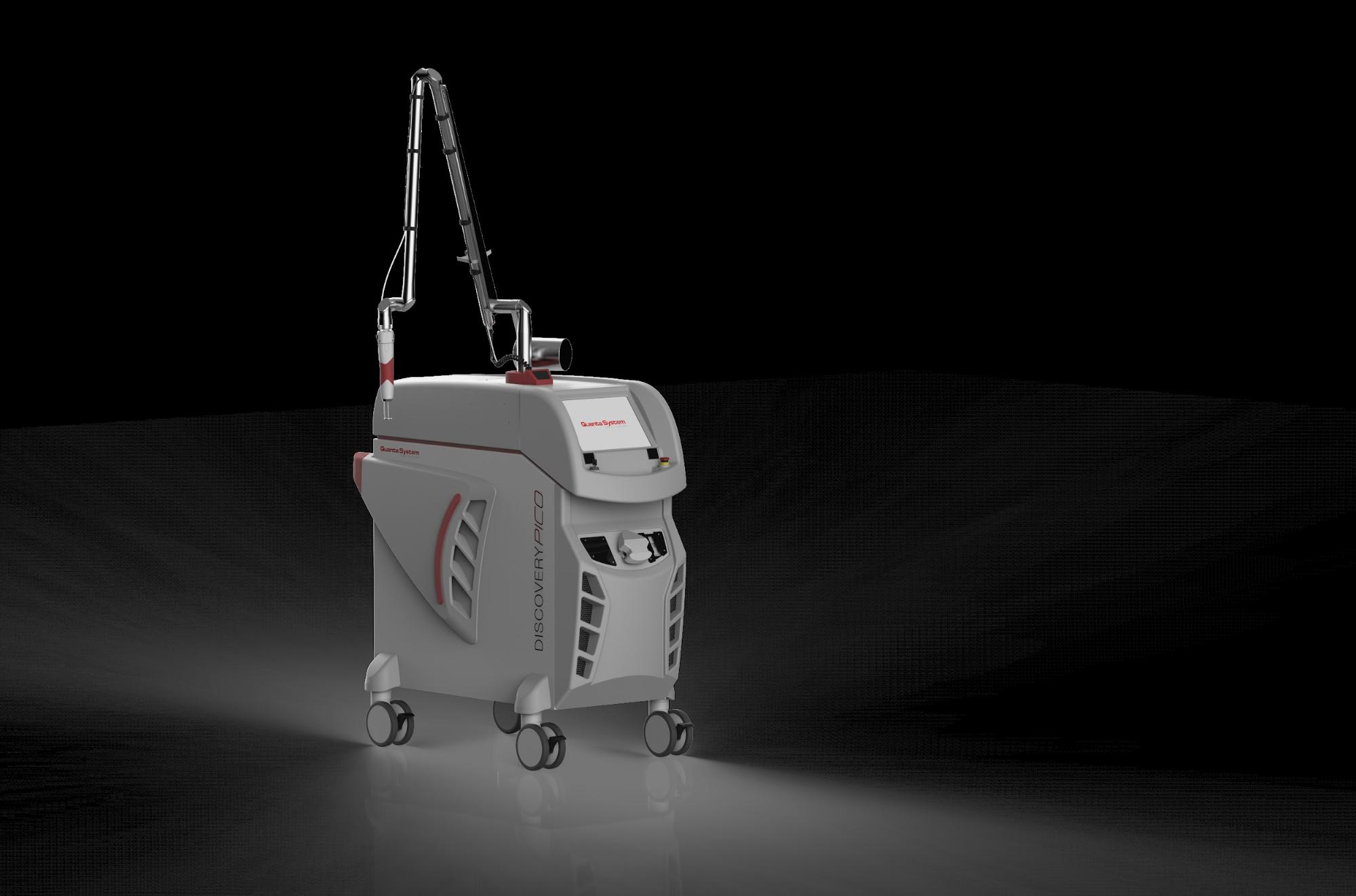
The Discovery PICO Plus used at Tamachi Ekimae Dermatology, Clinica Riviera Shibaura, is equipped with three lasers, the ruby laser (wavelength 694 nm), the YAG laser (wavelength 1,064 nm), and the KTP laser (wavelength 532 nm); of these, the ruby can emit in nanoseconds, and the YAG and KTP can emit in both nanoseconds and picoseconds. This means it can be used as five different lasers: the Q-switched ruby laser, the Q-switched YAG laser, the pico YAG laser, the Q-switched KTP laser, and the pico KTP laser.
| Discovery PICO’s Three Laser Types | |||
|---|---|---|---|
| KTP laser | Ruby laser | Nd:YAG laser | |
| Wavelength | 532 nm | 694 nm | 1064 nm |
| Picosecond | Yes | No | Yes |
| Modes | Spot, Toning, Fractional | Spot, Toning, Fractional | Toning (pico / nano), Pico-fractional |
| Characteristics | Reacts to melanin and hemoglobin | Absorbed by pigment such as melanin, but barely absorbed by normal skin or blood vessels (does not react even where there is redness) | Multiple settings allow versatile effects (mildly targets melanin and redness; also effective on acne) |
| Best for | Solar lentigines (age spots), freckles, seborrheic keratosis | Pigmented spots (incl. dark spots), birthmarks, full-face brightening, ADM | Pigmented spots, melasma, dullness, acne, rejuvenation, etc. |
The Difference Between Q-Switched Lasers and Pico Lasers
When a laser is applied, the target substance is broken down, but energy is also transmitted to the surroundings, burning the tissue with heat. In treating spots, with the conventional Q-switched (nanosecond) laser, the surroundings get burned and a burn-induced spot called post-inflammatory hyperpigmentation forms, so the spot often appears to have become darker instead. Because the pico laser irradiates for only a short time compared with the nanosecond laser, it causes less burning of the surrounding tissue, so this side effect can be expected to be reduced.
However, the pico laser is not unconditionally better than the Q-switched laser; the Q-switched laser also has the aspect of reacting more firmly and working well, so it is important to understand the differences and use them selectively.
Irradiation with a Large Spot Size Is Possible
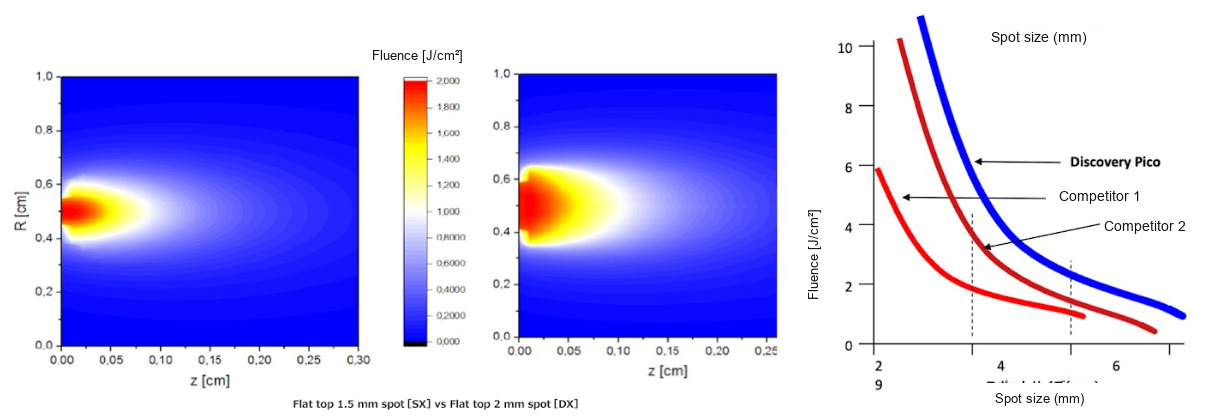
The Discovery PICO Plus has an overwhelmingly higher maximum output than other pico lasers, so irradiation with a large spot size is possible. Because the spot size is large, the laser’s power reaches into deeper layers.
In Pico Fractional Mode, Two Types of Irradiation Are Possible: Ablative and Non-Ablative
The Discovery PICO Plus is equipped with the only fractional laser among pico lasers that can perform vaporization. (As of October 2025)
① Ablative (shaving the skin)
Conventional ablative treatments had a high effect of renewing the skin, but the downside of a high incidence of pain, long downtime, and post-operative pigmentation. The Discovery Pico keeps the effect of the ablative type while reducing pain and skin damage, enabling a treatment in which pigmentation is also less likely.
② Non-ablative (not shaving the skin)
A typical pico fractional laser is the non-ablative type. The shock wave of the pico laser creates microscopic cavities within the epidermis without damaging it and provides stimulation, activating the skin tissue and producing collagen and elastin.
| Types of Fractional Laser | ||
|---|---|---|
| Ablative | Non-ablative | |
| Method | Vaporizing (ablates the skin surface) | Non-vaporizing (does not ablate the skin) |
| How it works | The laser is delivered in tiny dots; the skin’s natural healing repairs these micro-channels | The laser delivers heat; the skin’s natural healing repairs the heat damage |
| Best for | Deep acne scars, enlarged pores, etc. | Skin rejuvenation, texture improvement, etc. |
| Other pico lasers | ✕ | ◯ |
Uniform Irradiation Is Possible
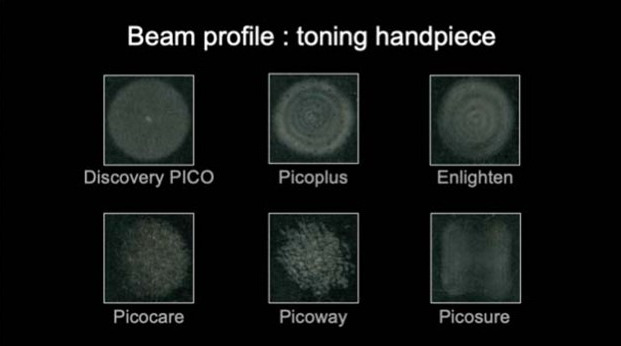
Compared with other pico lasers, the Discovery PICO Plus delivers laser energy evenly to the skin, so uniform irradiation without unevenness is possible. By preventing unevenness in the laser energy, it can also reduce the risk of side effects such as pigmentation.
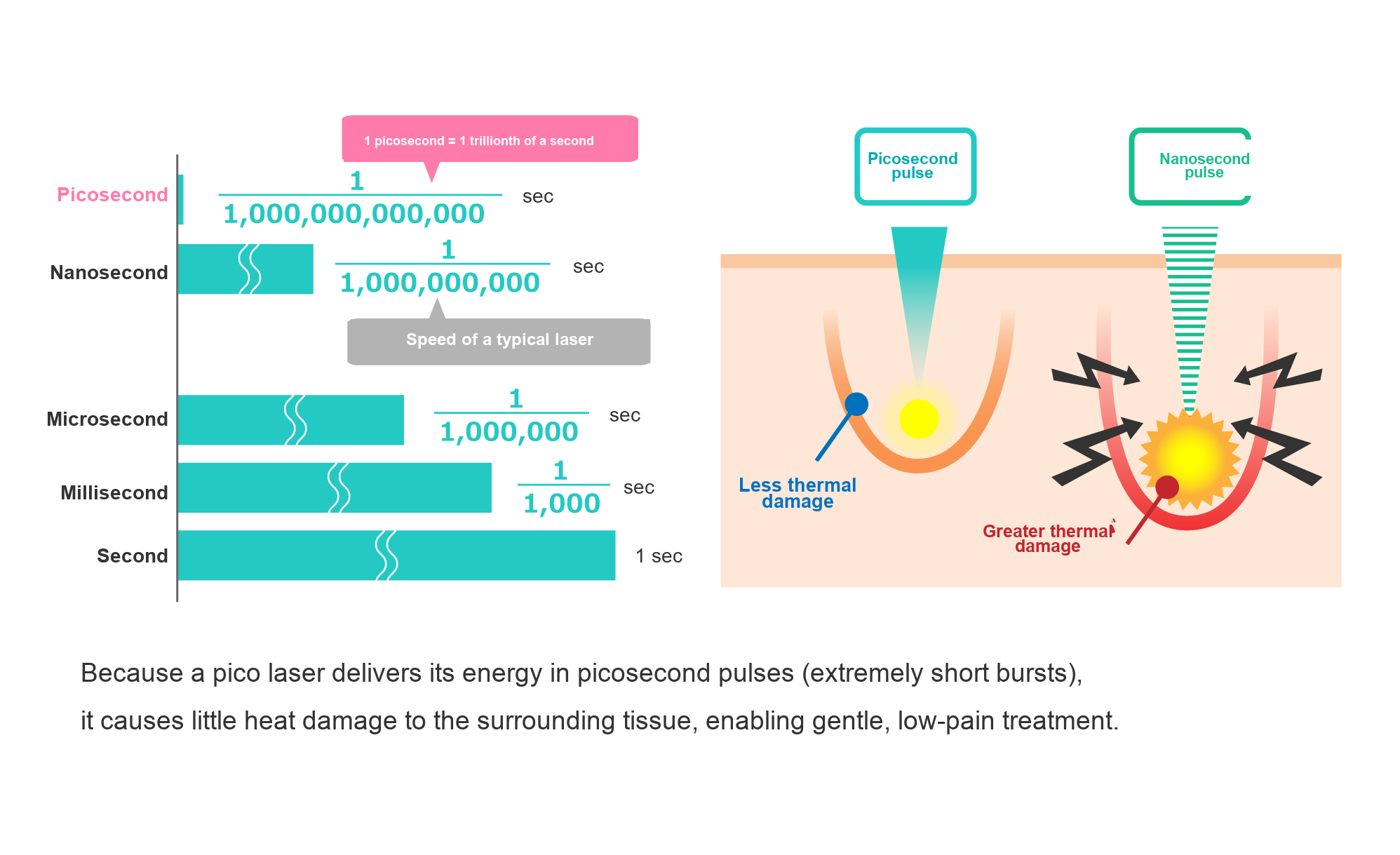
The pico laser irradiates for an extremely short time, on the order of picoseconds (one trillionth of a second), so it causes little damage to the surrounding tissue, enabling a treatment that is less painful and gentle on the skin.
Irradiation Methods of the Discovery PICO Plus
Pico Spot / Ruby Spot
For spots and pigmentation, a high-fluence laser is applied pinpoint. An effect can be expected from a single treatment.
Pico Fractional
The laser is applied in a dot pattern, giving fine changes to the dermis. This promotes the skin’s inherent regenerative power, so improvement in firmness and texture can be expected. Although high-fluence, it is a treatment that minimizes the burden and pain on the skin as much as possible.
Ruby Fractional
A new technique of applying the ruby laser in a dot pattern, mainly destroying melanin pigment selectively. By limiting the effect on the surrounding skin, it can shorten the downtime after treatment.
Also, by irradiating the whole face, it acts on the “hidden spots” that are hard to see on the surface, with the potential to suppress the future appearance of spots.
Pico Toning
A treatment that applies a low-fluence laser broadly over the whole face to help expel accumulated melanin. It is sometimes used to improve dullness, fine spots, and melasma, and an overall brightening of the skin can be expected.
Downtime, Side Effects, Risks, and Precautions
Downtime
- Pico Spot: over about a week a scab forms and the area appears to have darkened, then gradually peels off. Also, post-inflammatory hyperpigmentation may appear after the scab comes off.
- Pico Fractional: with the non-ablative type, the area may be red for a few days. With the ablative type, a scab forms over about a week and gradually peels off.
- Ruby Fractional: redness and a hot feeling may appear for a few days. Small dot-like scabs may also form over about a week.
- Pico Toning: there is almost no downtime. The skin may become slightly red after treatment, but it settles quickly.
Side effects and risks
- Bruising, redness, swelling, itching, pain, and a stinging sensation
- Pinpoint bleeding
- Pigmentation, loss of pigment
- Blisters, scabs
- Worsening of latent melasma
- Scarring
Precautions
The following people cannot receive the treatment.
- Those who are excessively tanned or who plan to tan
- Those who are pregnant or breastfeeding
- Those prone to keloids
- Those with photosensitivity
- Those with a history of epilepsy
- Those with a skin infection such as herpes at the treatment site
- Those taking an isotretinoin preparation (Accutane, Roaccutane, etc.) or within three months of stopping it
- Those with severe diabetes, heart disease, brain disease, or a malignant tumor
- Those with an autoimmune disease (such as connective tissue disease)
- Those taking or with a history of taking a gold preparation
What the Discovery PICO Plus Treats
Spots and freckles
Most spots are caused by ultraviolet light and are called solar lentigines. From the 30s onward they gradually begin to appear on the face and arms and grow larger and darker. The freckles from the cheeks across the nose that have been there since childhood are called ephelides. For solar lentigines and ephelides, shot irradiation with the pico YAG laser or the Q-switched ruby laser is a good fit.
Dullness
When there is no clearly defined spot but the dullness bothers you and you want to brighten your tone, Pico Toning and Ruby Fractional are a good fit.
Acquired Dermal Melanocytosis (ADM)
Unlike spots and freckles, where melanin is in the epidermis, the shallow layer of the skin, in acquired dermal melanocytosis melanin has increased in the dermis, the deep layer. It is typically a bluish gray, but can also be brownish and hard to distinguish from other spots. In addition to spot irradiation with the pico laser or ruby laser, Ruby Fractional together with other spots is also a good option.
Acne scars and enlarged pores
For red acne scars the pulsed dye laser V Beam is indicated, but for depressed acne scars the pico fractional laser is indicated. By making fine holes uniformly on the skin’s surface, the production of collagen and elastin is promoted during the wound-repair process, so a smoothing of the skin surface can be expected. Also, as the production of collagen and elastin becomes active, the skin’s firmness and elasticity improve, so an effect of making enlarged pores less conspicuous can also be expected. This is because, as the skin is plumped up from within, the pores tend to tighten.
Please also see these pages.