

Carbon Dioxide Laser
Carbon Dioxide Laser
e.f. Fractional CO2 Laser
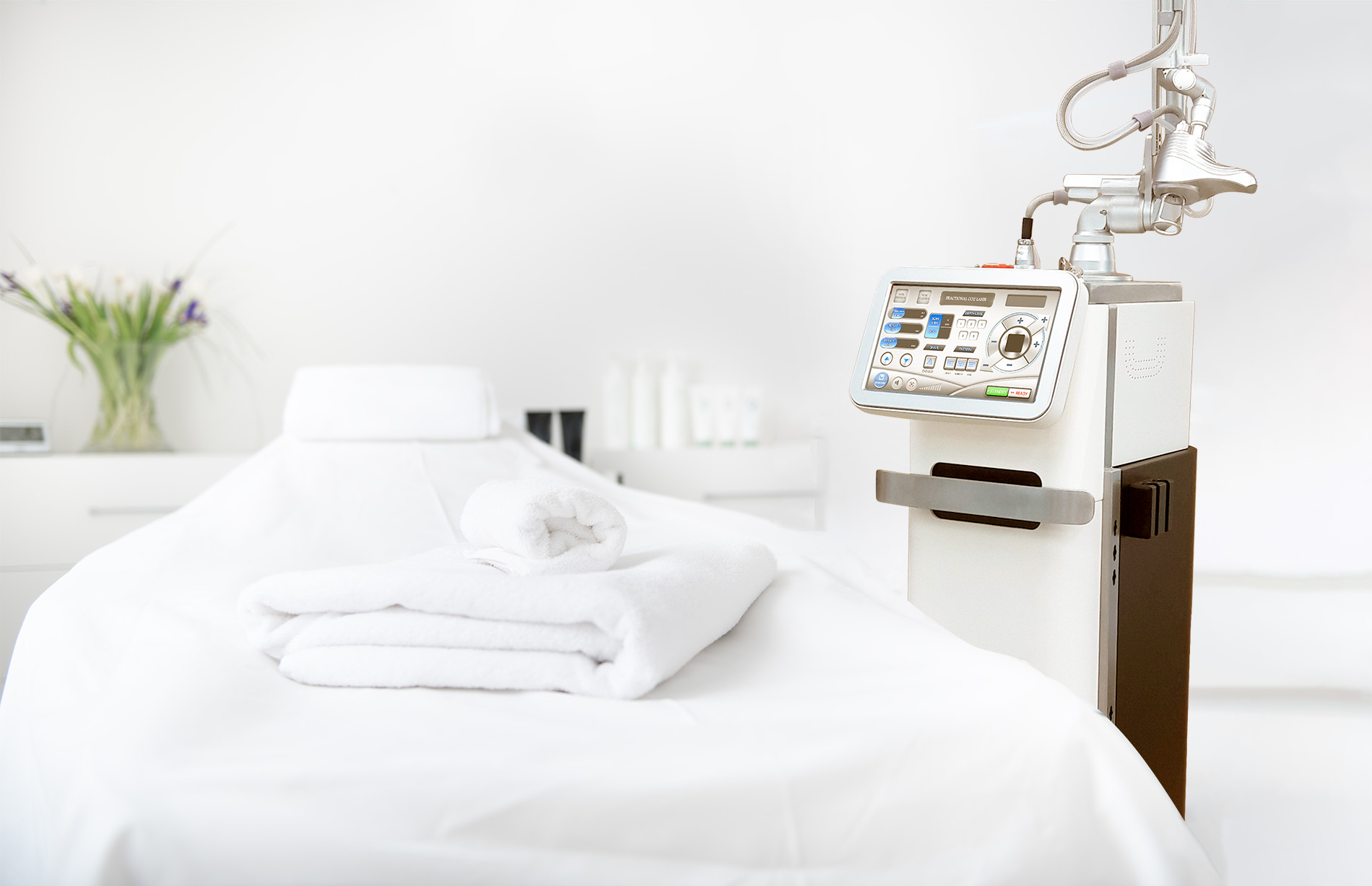
Cauterization with a carbon dioxide (CO2) laser is one treatment for benign tumors such as moles, warts, and syringomas. The carbon dioxide laser produces light with a wavelength of 10.6 μm that is highly absorbed by water. The laser light reacts with the water in the tissue and generates thermal energy, which incises, vaporizes, and coagulates the tissue.
At our clinic we use the e.f. Fractional CO2 Laser (a fractional CO2 laser) made by JMEC. In addition to a surgical mode, the e.f. is equipped with a scanner and fractional mode, a carbon dioxide laser that can perform incision, excision, vaporization, and fractional resurfacing in a single device.
Features of the e.f. Fractional CO2 Laser
Little bleeding
Because it quickly coagulates blood vessels too, treatment with little bleeding is possible.
Little damage to the surrounding skin
It can irradiate with strong power in a short time, enabling treatment with reduced thermal effect on the surrounding tissue.
Can treat even small lesions
The laser’s irradiation area can be varied from a small diameter of 0.1 mm up to 2 cm square, so it can be used for various lesions, such as small growths or cases near the eyes where it is difficult to cut with a scalpel.
A quick, same-day treatment
The procedure takes only a short time.
Conditions for Which the Carbon Dioxide Laser Is Indicated
- Pigmented nevus / nevocellular nevus (mole)
- Soft fibroma (skin tag)
- Seborrheic keratosis (wart)
- Syringoma
- and others
About post-operative care
- Each day after washing, apply an ointment and protect the wound with gauze, continuing for about one to three weeks until the wound closes.
- After the procedure, you will need to return for a follow-up visit at the specified time. Please also come in for an examination whenever you notice anything abnormal.
Side effects and risks
- An allergy to the anesthetic may occur.
- The wound can develop a bacterial infection.
- Irritation from post-operative topical medications, or side effects from oral medications (including allergy), can occur.
- The scar may be smaller or larger in area than the growth was.
As for color, it is standard for it to start out reddish and turn white over several months to several years; it is not usual for it to become completely undetectable. - Pigmentation or loss of pigment may remain at the scar.
- The scar may remain sunken, or conversely a hypertrophic scar or keloid (→ see here for details) may form.
- If the growth is removed only barely, part of it may remain or it may recur later.
- If a pathology test is performed and the growth turns out to be malignant, additional treatment may be necessary.
- Depending on the post-operative course, or at the time of re-operation, the diagnosis may change later.
Contraindications (those who cannot receive this treatment)
- Those who use a pacemaker or an implantable defibrillator
- Those who use an implanted medical device
- Those who are pregnant (safety has not been established)
- Those taking anticoagulants or who have a thromboembolic condition
- Other cases where the doctor judges it inappropriate
Precautions
- Those with a condition that affects wound healing, such as diabetes, may heal more slowly.