

Dermoscope
What Are a Dermoscope and Dermoscopy?
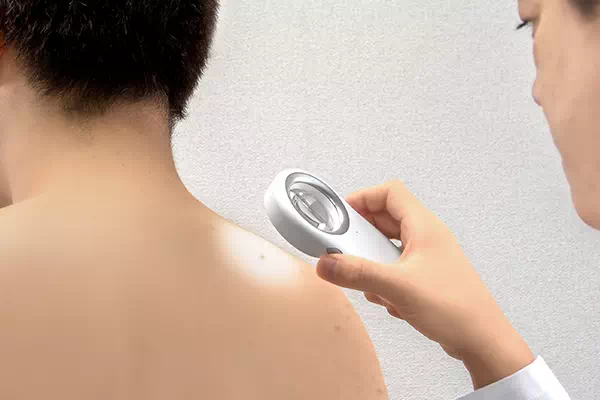
A dermoscope is a medical loupe (magnifier) used to closely examine skin spots, moles, growths, and the like under magnification. An examination in which the skin is viewed using a dermoscope is called dermoscopy.
It can distinguish not only the surface of the skin but also the deeper structures and subtle differences in color. It is used in dermatology to examine all kinds of skin lesions: identifying the types of spots and birthmarks, distinguishing benign moles from melanoma, examining the nature of small bumps and the degree of blood-vessel dilation, and checking for signs of connective tissue disease at the base of the nails.
What Are Polarized and Non-Polarized Modes?
A dermoscope offers two viewing methods: a polarized mode and a non-polarized mode.
- In polarized mode, removing the light reflected from the skin’s surface allows the deeper structures of the skin (blood vessels, pigment, dermis) to be observed clearly. It can also be used without contact, allowing a faster examination.
- In non-polarized mode, fine changes on the skin’s surface (the keratin layer, surface shape) can be observed. When necessary, gel is applied to the skin and the device is placed in contact to observe.
By using these two modes selectively, we can evaluate skin lesions from multiple perspectives and arrive at a more accurate diagnosis.
The Dermoscopes We Use at Our Clinic
Non-contact dermoscope: DZ-S50 (CASIO)
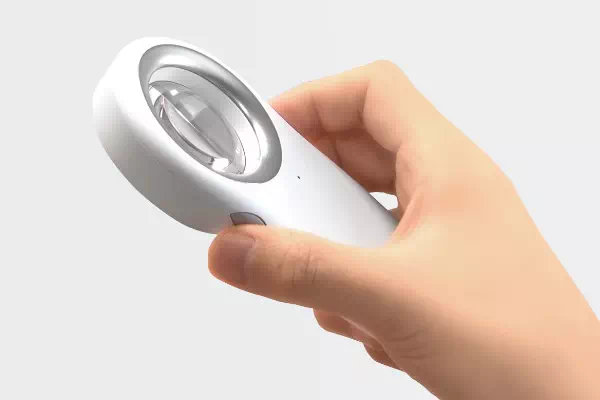
At our clinic we mainly use a non-contact dermoscope made by Casio. Because it allows observation without touching the skin, it is hygienic, places less burden on the patient, and enables a smooth examination.
When necessary, we also use a dedicated conversion lens to examine at higher magnification in greater detail.
Camera with contact dermoscope function: DZ-D100 (CASIO)
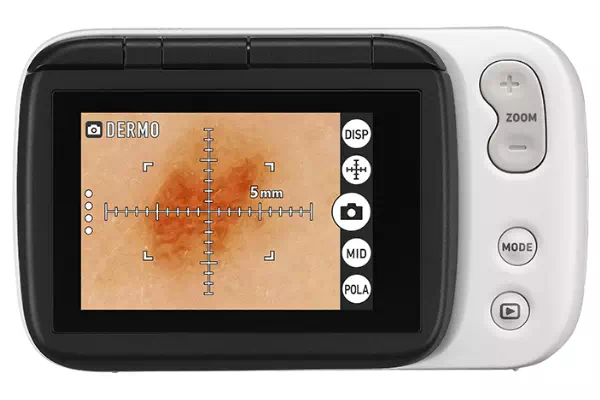
This device is used as a contact dermoscope, observing by touching the skin lightly. Placing it firmly against the skin captures the internal structure of the skin more clearly and aids accurate diagnosis. Narrow areas such as between the fingers, around the eyes, and the entrance of the ear are hard to bring the dermoscope close to, but they can be observed using a small-diameter adapter. A three-dimensional adapter can also be used to thoroughly observe a raised growth without crushing it.